Accelerating Europe’s Green Manufacturing Transition
GENESIS Masterclasses is an international online learning and collaboration programme designed to support companies and innovation actors in their transition towards circular, green and digitally enabled manufacturing.
The programme is part of GENESIS – Greening Economy Network for Enhancing Sustainable Industrial Systems, an EU-funded project that aims to strengthen European innovation ecosystems, foster interregional cooperation and support the development of sustainable industrial systems.
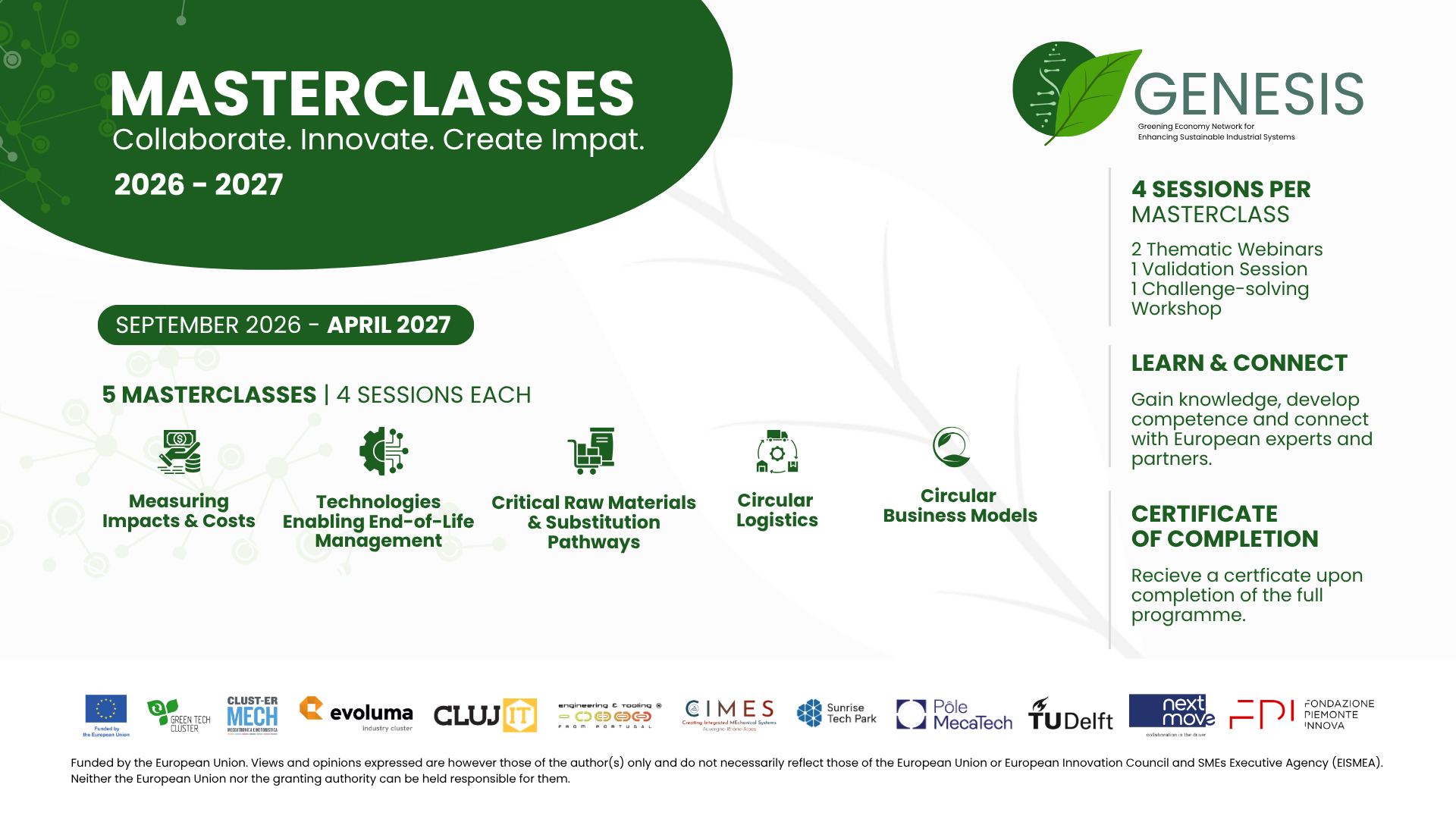
The programme is built around 5 key themes, each explored through 4 connected masterclass sessions. The first two sessions focus on expert-led activating education, while the third and fourth sessions are designed to be shaped around the participants’ own challenges, needs and collaboration interests.
In total, the programme will include 22 online events: 5 thematic tracks x 4 masterclass sessions
Why participate?
gain practical knowledge on circular economy, green manufacturing and digital transformation
learn from international experts, researchers and industry practitioners
explore tools and approaches such as life cycle assessment, circular logistics, critical raw material risk mapping, eco-design and circular business models
connect with companies, clusters, research organisations and innovation support actors from other European regions
work on real challenges relevant to their own organisation or sector
contribute to the design of practical workshop sessions based on their own needs and interests
identify potential partners for future interregional cooperation
learn about European funding opportunities for circular economy and green manufacturing projects
develop ideas that may lead to future joint projects, business cases or innovation initiatives
The programme is suitable both for organisations already working with circular economy solutions and for those beginning to explore how to make their products, processes or business models more sustainable.
No prior expert knowledge is required, but participants should have an interest in practical circular economy or green manufacturing solutions.
GENESIS Masterclasses are designed not only as a training programme, but also as a practical entry point into European collaboration.
The 5 Thematic tracks
The GENESIS Masterclasses programme consists of 5 thematic tracks. Each track includes 4 connected masterclass sessions.
Each theme follows the same structure that allows participants to first build a shared knowledge base and then actively apply that knowledge to challenges that are relevant to them.
This track helps participants understand how to assess the environmental and economic performance of products, processes and circular economy solutions. It introduces practical tools that can support better decision-making in sustainable industrial development.
Session 1 – LCA: Life Cycle Assessment
Speaker: Samantha Tanzer, TU Delft, Faculty of Technology, Policy and Management
Date and time: Monday, 23 November 2026, 13:00–15:00 CET
Format: Expert-led masterclass / activating education
This masterclass introduces the basics of life cycle assessment, a method used to quantify and compare the environmental impacts of products and services. Participants will gain an overview of the LCA process and learn how LCA can support different stages of industrial process development.
The session will also address what questions LCA can and cannot answer, common pitfalls in using LCA, and how the method can be applied to cases of interest to participants. Time will be included for questions and discussion.
Session 2 – Techno-Economic Assessment
Speaker: Ali Abdelshafy, TU Delft, Faculty of Technology, Policy and Management
Date and time: Tuesday, 1 December 2026, 13:00–14:30 CET
Format: Expert-led masterclass / activating education
This masterclass introduces techno-economic assessment as a practical approach for evaluating the economic viability of technologies, with a focus on emerging green-tech applications.
Participants will learn about the key steps involved in conducting a techno-economic assessment, including cost estimation, performance metrics, assumptions and uncertainty. The session will also explore how TEA can inform decision-making at different stages of technology development, its limitations, and the types of questions it is best suited to address.
An interactive discussion will allow participants to raise questions and explore how TEA can be applied to their own cases and contexts.
Session 3: Deep dive for next steps
To be held in the months of January and February 2027
In the 1st and 2nd masterclass we learned about the newest developments, but how can we apply this in practice?
In this third masterclass we dive deeper with the group into the new developments and how they might help the different regions and the regional partners to make next steps in their development.
Using a VEVOX quiz tool we will identify the most urgent challenges of the partners and their peers that might be the right partner to address these challenges. The attendees will be challenged in their knowledge and their challenges and will find their complementary partners that can bring knowledge and experience to the table your organisation needs.
Session 4: Idea’s, solutions and collaboration
To be held in the months of March and April 2027
In the 3rd session we focused on the next steps in the development of your organization. The mix of partners bringing in their knowledge and experience can be matched with the needs and challenges of your organization.
In this hands-on workshop the participants work in small teams to tackle an industrial challenge that was discussed in the 3rd session, and come up with ideas for solutions. In the shaping of idea’s, the main trade-offs in terms of technical performance, economic cost and supply or operational risk are also discussed. The idea’s should lead to a competitive advantage for your region in the EU. These ideas together with the initial matches between research partners and SME’s might be the starting point for future collaboration in European funded projects, and will be the first step towards the dedicated webinars on European funding opportunities.

Registration for a thematic track includes access to all four sessions within that track.
This track explores technologies and strategies that help recover value from products and materials at the end of their life cycle. It focuses on solutions that support better sorting, reuse, repair, refurbishment, remanufacturing and material recovery.
Session 1 – AI-Driven Sorting and Material Recognition
Speaker: Shalini Singh, University of Twente
Additional case presenters: Gabriella Kroth Zilian and Kentaro Nagai
Date and time: Wednesday, 21 October 2026, 10:00–12:00
Format: Expert-led masterclass / activating education
This masterclass introduces AI-driven sorting and material recognition as one of the newest technologies used to separate particles and support more efficient pre-sorting for recycling.
Participants will learn how artificial intelligence and neural networks can be used for waste classification and sorting. The session will explore how better separation technologies can contribute to higher recovery rates and improved material fractions, including those containing critical raw materials.
The session will also include practical applications of this technology.
Session 2 – Advanced E-Waste Management: Stop Electronics Going Down the Waste Route While Making Cash
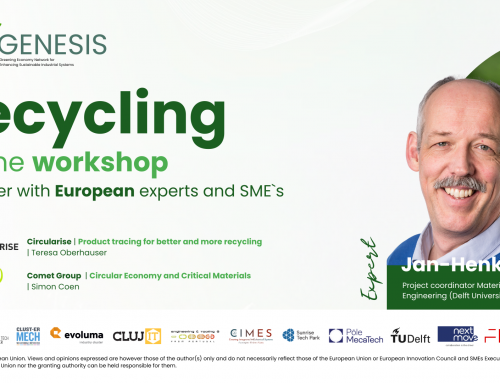
Speakers: Jan-Henk Welink, TU Delft; Jelle Bunt, Reconext; Cor Mulder, JC Electronics
Date and time: Tuesday, 17 November 2026, 14:30–16:00
Format: Expert-led masterclass / activating education
This masterclass focuses on advanced e-waste management, especially the higher-value steps in the reduce-reuse-recycle approach: reuse, repair, refitting, refurbishment and remanufacturing.
Instead of looking only at recycling, this session explores how electronic products can be repaired, refurbished and reused before they become waste. By preserving the functional value of products, organisations can achieve greater economic value than through material recycling alone.
The session will provide an overview of refurbishment and remanufacturing processes and include practical examples from companies working in this field.
Session 3: Deep dive for next steps
To be held in the months of January and February 2027
In the 1st and 2nd masterclass we learned about the newest developments, but how can we apply this in practice?
In this third masterclass we dive deeper with the group into the new developments and how they might help the different regions and the regional partners to make next steps in their development.
Using a VEVOX quiz tool we will identify the most urgent challenges of the partners and their peers that might be the right partner to address these challenges. The attendees will be challenged in their knowledge and their challenges and will find their complementary partners that can bring knowledge and experience to the table your organisation needs.
Session 4: Idea’s, solutions and collaboration
To be held in the months of March and April 2027
In the 3rd session we focused on the next steps in the development of your organization. The mix of partners bringing in their knowledge and experience can be matched with the needs and challenges of your organization.
In this hands-on workshop the participants work in small teams to tackle an industrial challenge that was discussed in the 3rd session, and come up with ideas for solutions. In the shaping of idea’s, the main trade-offs in terms of technical performance, economic cost and supply or operational risk are also discussed. The idea’s should lead to a competitive advantage for your region in the EU. These ideas together with the initial matches between research partners and SME’s might be the starting point for future collaboration in European funded projects, and will be the first step towards the dedicated webinars on European funding opportunities.
Registration for a thematic track includes access to all four sessions within that track.
This track focuses on Europe’s dependency on critical raw materials and explores strategies to reduce supply risks through risk mapping, substitution, alternative materials, recycling and design choices.
Session 1 – Critical Raw Materials Risk Mapping
Speaker: Toni Gallone, Impulse CRM
Date and time: Wednesday, 14 October 2026, 14:00–16:00
Format: Expert-led masterclass / activating education
Many industrial products contain critical raw materials, such as neodymium in electric motors or copper in electrical wires. Disruptions in supply chains can make production difficult or even impossible.
This masterclass explains how to map the risks related to critical raw materials in products and value chains. Participants will learn why risk mapping is important and how it can support better strategic decisions.
The session will include practical examples from the automotive industry.
Session 2 – Alternative and Low-Impact Materials
Speakers: Jan-Henk Welink and Malte Vogt, TU Delft
Date and time: Tuesday, 10 November 2026, 14:00–16:00
Format: Expert-led masterclass / activating education
This masterclass explores how alternative and low-impact materials can help reduce dependency on critical raw materials.
Because products and critical raw material-containing alloys vary widely, there is no single standard approach for replacing these materials while maintaining product functionality and performance. The session will therefore use two practical cases: one focused on alloys and one focused on a PV panel.
Through these cases, participants will gain a better understanding of how to search for alternatives, evaluate trade-offs and identify possible substitution pathways.
Session 3: Deep dive for next steps
To be held in the months of January and February 2027
In the 1st and 2nd masterclass we learned about the newest developments, but how can we apply this in practice?
In this third masterclass we dive deeper with the group into the new developments and how they might help the different regions and the regional partners to make next steps in their development.
Using a VEVOX quiz tool we will identify the most urgent challenges of the partners and their peers that might be the right partner to address these challenges. The attendees will be challenged in their knowledge and their challenges and will find their complementary partners that can bring knowledge and experience to the table your organisation needs.
Session 4: Idea’s, solutions and collaboration
To be held in the months of March and April 2027
In the 3rd session we focused on the next steps in the development of your organization. The mix of partners bringing in their knowledge and experience can be matched with the needs and challenges of your organization.
In this hands-on workshop the participants work in small teams to tackle an industrial challenge that was discussed in the 3rd session, and come up with ideas for solutions. In the shaping of idea’s, the main trade-offs in terms of technical performance, economic cost and supply or operational risk are also discussed. The idea’s should lead to a competitive advantage for your region in the EU. These ideas together with the initial matches between research partners and SME’s might be the starting point for future collaboration in European funded projects, and will be the first step towards the dedicated webinars on European funding opportunities.
Registration for a thematic track includes access to all four sessions within that track.
This track focuses on the operational side of circular economy implementation. It explores how organisations can manage reverse flows, improve collection systems and recover materials more effectively.
Session 1 – Reverse Logistics Management
Speaker: Marcel Ludema, TU Delft, Faculty of Technology, Policy and Management
Date and time: Thursday, 1 October 2026, 09:00–10:30
Format: Expert-led masterclass / activating education
To reuse, remanufacture or even recycle returned and end-of-life products the first step is getting these products back in large enough quantities at the right place. Organising reverse logistics is a crucial step in a circular business, it far more complex because each returned or recovered product took a different path in the first use. Revers logistics not only contains transport, but also product recovery, inspection, and buffering of collected products on warehouses. This all evolves in the direction of closed-loop supply chain. If this reverse operation is not organized effective and efficient, it will lead to higher costs, making a circular business not competitive. This master class explains how reverse logistics can be managed and how this is part of closed-loop supply chains.
Session 2 – Optimising Collection and Material Recovery
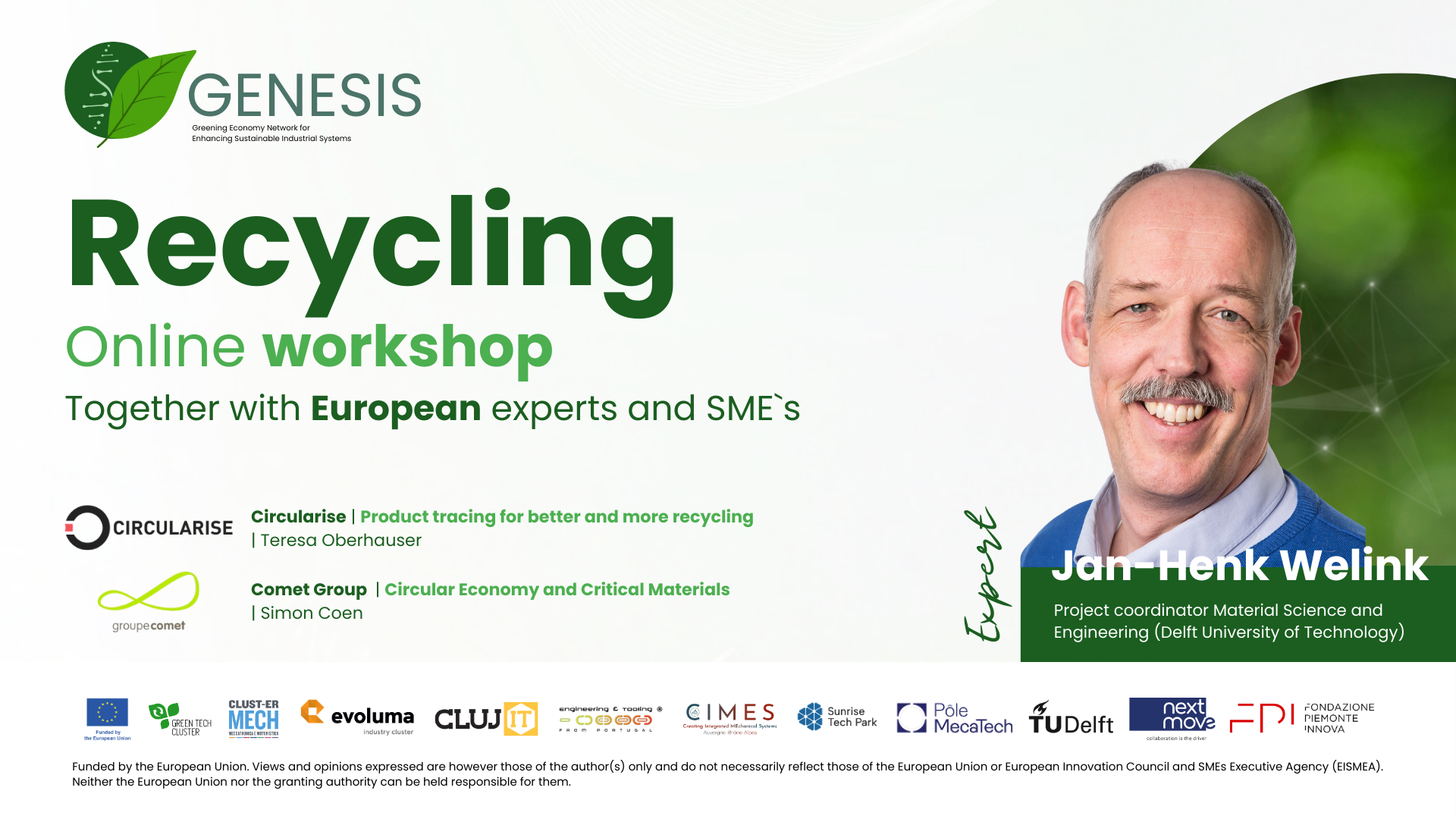
Speaker: Jan-Henk Welink, TU Delft, Mechanical Engineering
Date and time: Wednesday, 4 November 2026, 14:00–16:00
Format: Expert-led masterclass / activating education
Recovering materials from discarded products is not only a technical task. It also depends on whether enough products are collected and whether the collection, separation and recycling steps work effectively together.
This masterclass provides an overview of the three necessary steps for recovering materials from waste products: collection, separation and recycling.
Examples will be presented, and participants will be encouraged to bring their own cases to discuss each step in the process.
Session 3: Deep dive for next steps
To be held in the months of January and February 2027
In the 1st and 2nd masterclass we learned about the newest developments, but how can we apply this in practice?
In this third masterclass we dive deeper with the group into the new developments and how they might help the different regions and the regional partners to make next steps in their development.
Using a VEVOX quiz tool we will identify the most urgent challenges of the partners and their peers that might be the right partner to address these challenges. The attendees will be challenged in their knowledge and their challenges and will find their complementary partners that can bring knowledge and experience to the table your organisation needs.
Session 4: Idea’s, solutions and collaboration
To be held in the months of March and April 2027
In the 3rd session we focused on the next steps in the development of your organization. The mix of partners bringing in their knowledge and experience can be matched with the needs and challenges of your organization.
In this hands-on workshop the participants work in small teams to tackle an industrial challenge that was discussed in the 3rd session, and come up with ideas for solutions. In the shaping of idea’s, the main trade-offs in terms of technical performance, economic cost and supply or operational risk are also discussed. The idea’s should lead to a competitive advantage for your region in the EU. These ideas together with the initial matches between research partners and SME’s might be the starting point for future collaboration in European funded projects, and will be the first step towards the dedicated webinars on European funding opportunities.
Registration for a thematic track includes access to all four sessions within that track.
This track supports participants in rethinking business models so that circularity becomes a driver of innovation, competitiveness and long-term value creation.
Session 1 – Eco-Design for Performance and Market Differentiation
Speaker: Jeremy Faludi, TU Delft, Industrial Design Engineering
Date and time: Wednesday, 7 October 2026, 13:00–15:00 CET
Format: Expert-led masterclass / activating education
Quantitative Sustainable Design Decisions: using life cycle assessment to make evidence-based goals and decisions
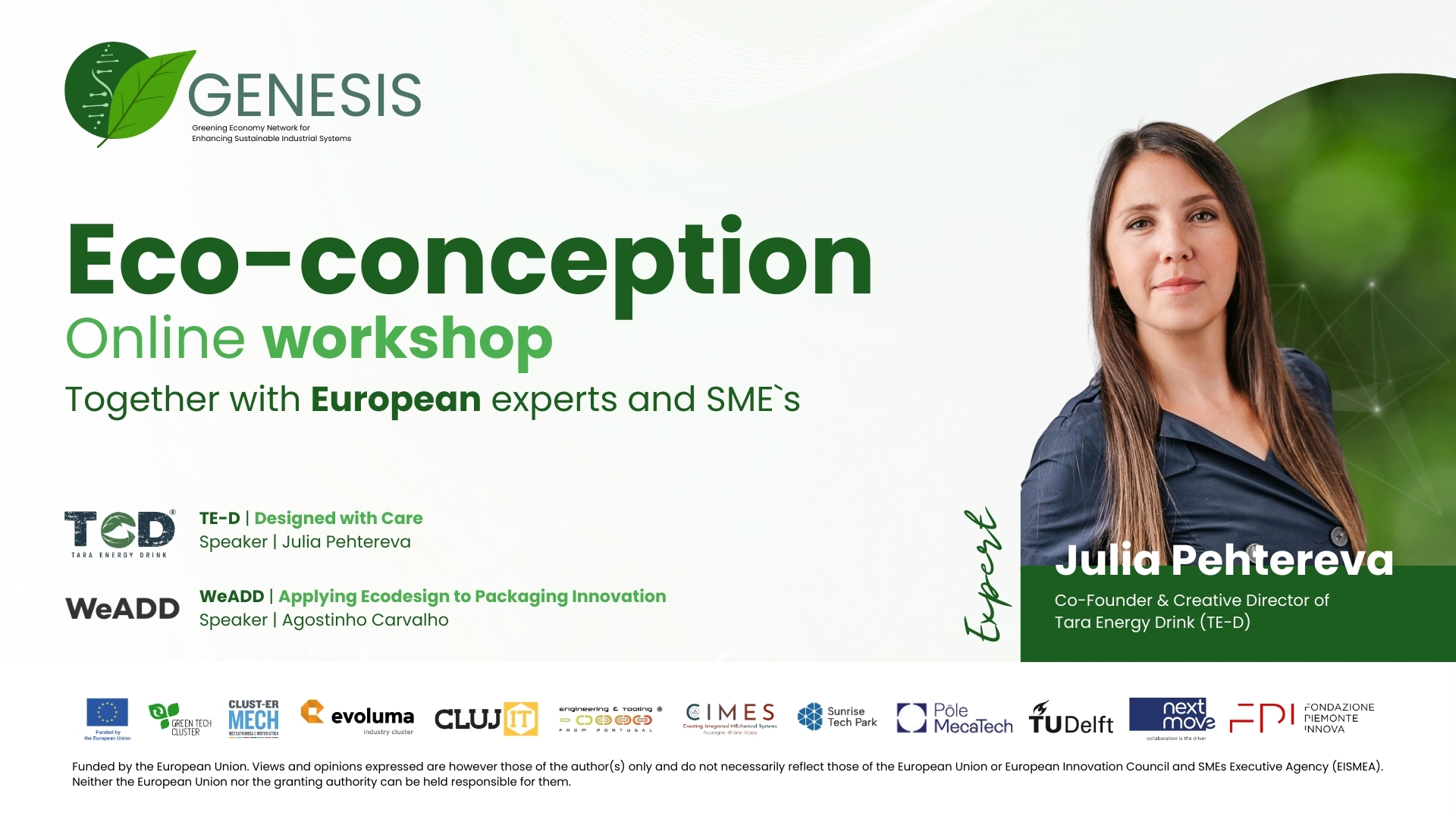
This workshop introduces the basics of life cycle assessment and shows how its system-wide quantification of impacts can support better design decisions. Participants will learn how LCA can help focus redesign efforts on the largest impacts, compare design options and avoid greenwashing.
The session will cover how to read existing LCAs, what LCAs do and do not show, how to conduct fast-track LCAs and how to avoid common mistakes. It will also discuss how LCA can be integrated into product or service development processes.
The workshop is based on Dr. Jeremy Faludi’s book Sustainable Design from Vision to Action. A free digital copy of the book is included with the course.
Audience: Engineers, designers and business managers at companies that manufacture products, provide services or consult on product development. The session is also relevant for academics, SMEs and large companies.
Session 2 – Circular Business Models and Circular Revenue Calculation
Speaker: Koen Dittrich, Erasmus University Rotterdam
Date and time: Friday, 30 October 2026, 14:00–16:00 CET
Format: Expert-led masterclass / activating education
This workshop explores how sustainable and circular business models can support green-tech innovation and create multiple forms of value.
Participants will be introduced to key concepts such as circular economy strategies, sustainable value creation and business model innovation. Through examples, discussion and a hands-on exercise, participants will identify opportunities for collaboration and future EU project development.
The session also encourages knowledge exchange and networking among academics, companies and SMEs across Europe.
Session 3: Deep dive for next steps
To be held in the months of January and February 2027
In the 1st and 2nd masterclass we learned about the newest developments, but how can we apply this in practice?
In this third masterclass we dive deeper with the group into the new developments and how they might help the different regions and the regional partners to make next steps in their development.
Using a VEVOX quiz tool we will identify the most urgent challenges of the partners and their peers that might be the right partner to address these challenges. The attendees will be challenged in their knowledge and their challenges and will find their complementary partners that can bring knowledge and experience to the table your organisation needs.
Session 4: Idea’s, solutions and collaboration
To be held in the months of March and April 2027
In the 3rd session we focused on the next steps in the development of your organization. The mix of partners bringing in their knowledge and experience can be matched with the needs and challenges of your organization.
In this hands-on workshop the participants work in small teams to tackle an industrial challenge that was discussed in the 3rd session, and come up with ideas for solutions. In the shaping of idea’s, the main trade-offs in terms of technical performance, economic cost and supply or operational risk are also discussed. The idea’s should lead to a competitive advantage for your region in the EU. These ideas together with the initial matches between research partners and SME’s might be the starting point for future collaboration in European funded projects, and will be the first step towards the dedicated webinars on European funding opportunities.
Registration for a thematic track includes access to all four sessions within that track.
What is expected from participants?
Participants are encouraged to take an active role in the programme.
join the expert-led masterclasses;
reflect on how the topics relate to their own organisation or region;
contribute questions, examples or challenges;
take part in the participant-driven sessions;
explore possible collaboration opportunities with other participants.
The third and fourth sessions of each thematic track will be shaped around participant input, making the programme more practical, relevant and connected to real industrial needs.
Certificate of Completion
Participants who complete the 4 required sessions of a thematic track will receive a Certificate of Completion.
Registration
Participation in GENESIS Masterclasses is free of charge.
Register now to join an international learning and collaboration programme focused on circular economy, green manufacturing, digital transformation and European innovation cooperation.
Registration for one thematic track includes access to all four sessions within that track.
European funding webinars
In addition to the 5 thematic tracks, the programme will include 2 dedicated webinars on European funding opportunities.
These sessions will help participants better understand:
- relevant European funding instruments for circular economy and green manufacturing projects;
- eligibility criteria and project readiness requirements;
- typical consortium structures;
- how to develop collaboration ideas into realistic project concepts;
- how SMEs and innovation actors can participate in future European initiatives.
The funding webinars are designed to support the continuation and scaling of ideas developed during the masterclasses and challenge-solving workshops.
#I3Instrument #GENESISproject #CircularEconomy #GreenEconomy #SustainableManufacturing #ResourceEfficiency #EUinnovation #EUFunds #GreenDeal
Funded by the European Union. Views and opinions expressed are however those of the author(s) only and do not necessarily reflect those of the European Union or the European Innovation Council and SMEs Executive Agency (EISMEA). Neither the European Union nor the granting authority can be held responsible for them